The Steamboat sign hangs in this room.
Sixth Street, 1978 to 1999. The loudest door on the street, and the marquee that outlived it.
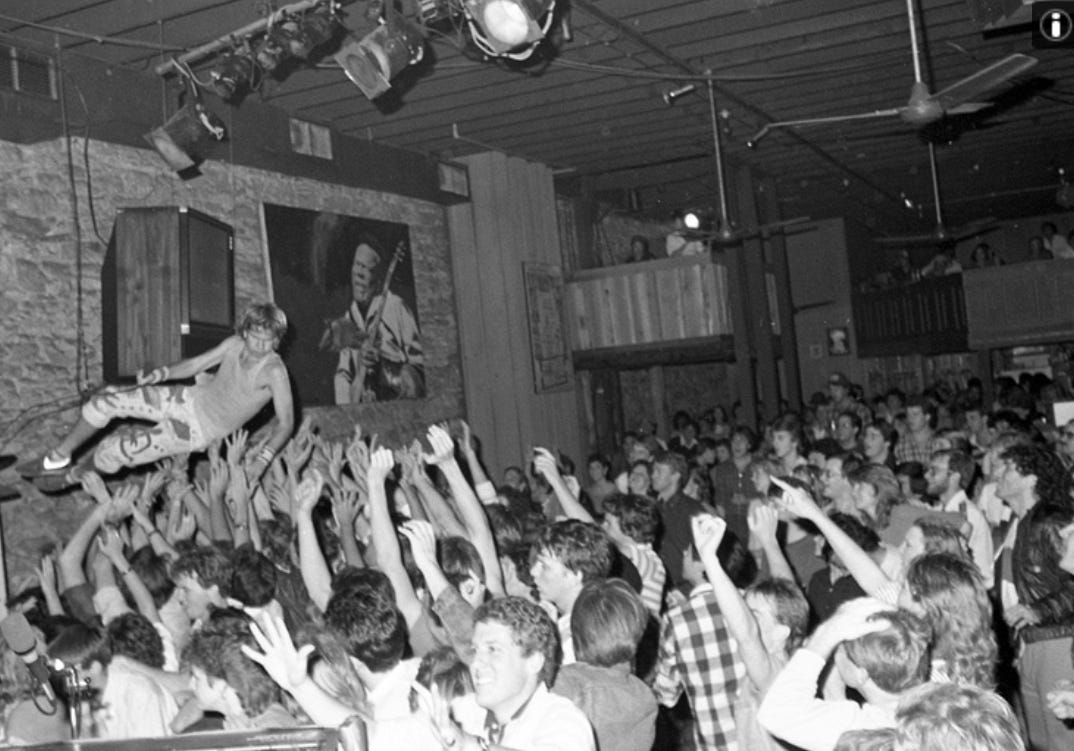
For twenty-one years Steamboat was where Austin bands went to become Austin bands. It sat on Sixth Street through the stretch when that street still belonged to music rather than to bachelor parties, and it ran on a principle almost no venue runs on now: the door money went to the people who filled the room.
What the room actually was
Steamboat was not a listening room and it was not a theatre. It was loud, it was narrow, and it booked bands on the way up rather than bands who had already arrived. That combination is rarer than it sounds — most venues do one or the other.
The booking was democratic in a way that would be commercially reckless today. New bands got Monday and Tuesday. If people came, they moved up the week. If they kept coming, they got a weekend. Nobody bought a slot.
Which meant the calendar was a fairly accurate map of what Austin actually wanted to hear at any given moment, updated weekly, and everyone in the scene read it that way.
It also meant the club took the risk. A venue that pays a band based on the door in a week they drew forty people is a venue absorbing the cost of finding the next one.
The Monday night that turned into a record deal
In 1995 three brothers named Vallejo talked their way into the Monday slot. Monday is where clubs put bands they are not sure about. They played it until the weekend belonged to them, and a year later a SXSW set on that stage turned into a record deal and a single at number 30 on the Billboard Alternative chart.
That is not a story about one band getting lucky. It is what the room was built to do, and it did it repeatedly for two decades. The longer version is here.
1999, and where the sign went
The club closed in September 1999. KVUE filmed the last night. Sixth Street kept changing after that in the direction everyone expected, and most of what made that stretch matter to musicians went with it.
The marquee did not go into a landfill or an antiques dealer. It came to South Austin, and it has been lit above this studio ever since — now hanging in the middle of the record wall, surrounded by albums made underneath it.
You can hear why that matters on the records. A room with a history behaves differently, because the people playing in it behave differently.
Common questions
When was Steamboat open?
From 1978 until it closed in 1999, on Sixth Street in Austin.
Is the actual sign in the studio?
Yes. It hangs lit in the middle of the record wall at 2228 S Lamar, and you can come and see it.
Who ran the club?
Danny Crooks, who ran it through to the close and has been in Austin since 1970.
What made it different from other Austin venues?
The booking ladder and the door split. New bands started on Mondays and worked up to weekends on whether people came, and the money at the door went to the bands.